
by Sister Shamim
One of the goals for the believer is to remember Allah, subhanahu wa ta’ala (meaning may He be praised and exalted be blessed with unmeasurable goodness), day and night, and one of the best ways to do so is to learn the words that the Prophet, sallallahu ‘alayhi wa sallam, (meaning peace and blessings be upon him), taught us.
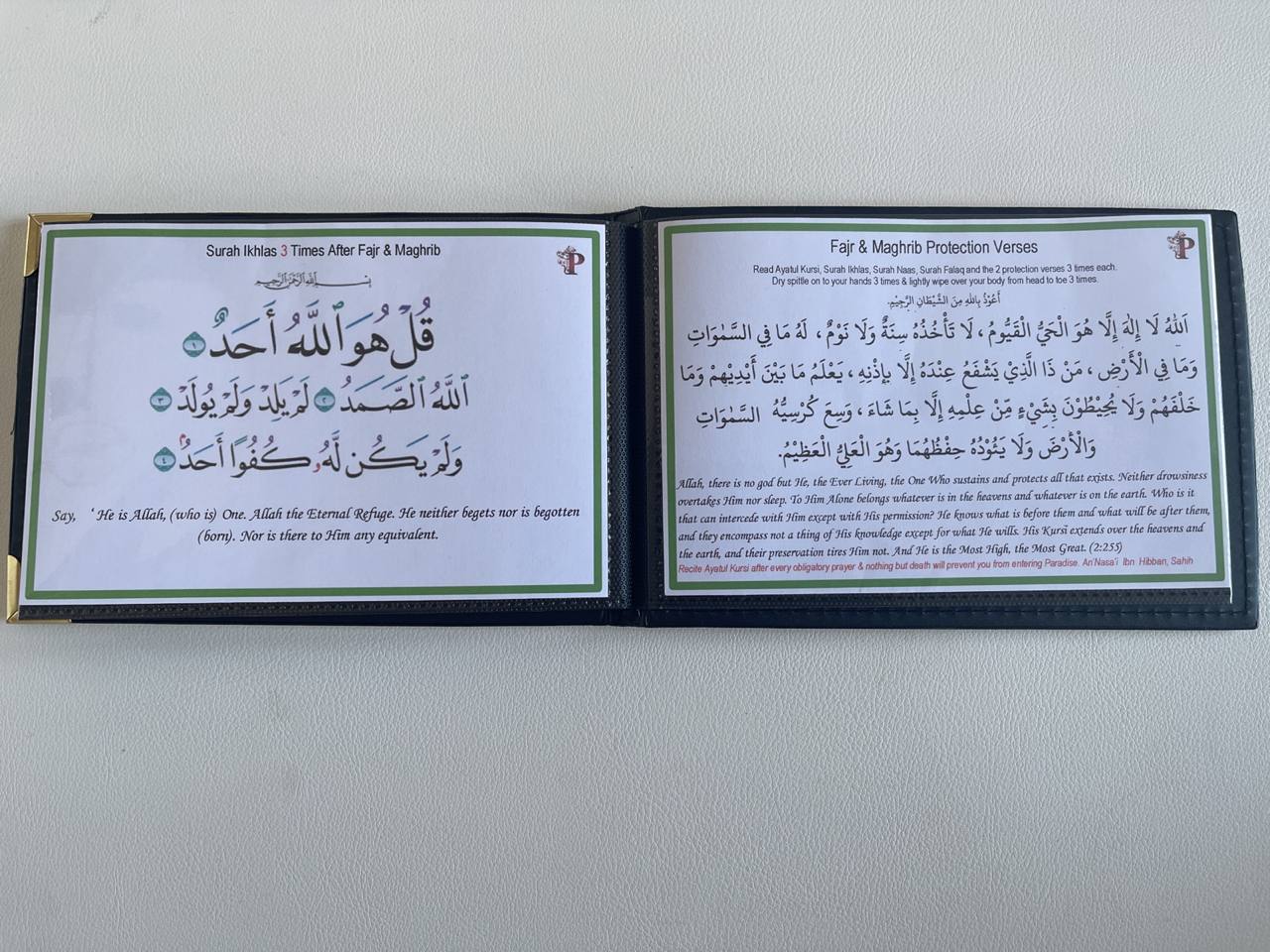
This du’a book has been slowly and lovingly created during my personal journey with salah and dhikr. I have a need to understand what I am reciting and why. I was so overwhelmed (Astagfir Allah) with all the du’as I should or could be reciting. I often could not recall the meaning or benefits of what I was reciting. I came across so many beneficial du’as, and I thought, “How am I ever going to be able to read them all?” Allah, subhanahu wa ta’ala (meaning may He be praised and exalted be blessed with unmeasurable goodness), changed my mindset around du’a and dhikr.
Initially, I had been taught to recite the basic dhikr after salah but did not have the knowledge or the benefit of understanding the meaning. I started thinking to myself, ‘I should know this!’ But I didn’t! So, with sincere intention to please Allah, subhanahu wa ta’ala (meaning may He be praised and exalted be blessed with unmeasurable goodness), I set out to learn and create a dhikr routine. I started to recite the protection dhikr after Fajr and Maghrib and gradually began to add small du’as that resonated with me and slowly built up my dhikr. I recently added the ‘Rabbana and Afiya du’as and the longer du’as praising our Lord.
My final stage of organizing my book was the order. This was when I realized others would benefit, and I wanted to share the du’as. I discovered I wanted to collect the du’as so I and others could locate and follow them easily. I became aware there was an etiquette to making du’a, and I discovered different variations of the etiquette of du’a. After research followed the format of praising my Lord, seeking forgiveness, sending Salawat to our Prophet Muhammad, sallallahu ‘alayhi wa sallam, (meaning peace and blessings be upon him), and finally making du’a. The result is a dhikr book which follows the format of the morning and evening adhkar, then my chosen du’as using the du’as etiquette. This order suits me and the way my brain works.
Du’as is very personal, and I no longer feel overwhelmed. I will continue to add more du’as I think I will benefit from as time goes on, but at the present moment, I am content.
I do not read all the du’as daily. I have my default ‘go to’ du’as and recite others as I need or want to, depending on my circumstance. I realize the quality and intention of my du’a recitation are more important than the quantity. I aim to recite clearly and slowly with tajweed and consciousness, rather than firing off the dhikr like fireworks shooting aimlessly into the sky. I often catch myself when I have gone into default ‘ high-speed mode’ and reprogram myself to connect with the words I am reciting. Astagfir Allah. Ultimately, who am I reciting to? Why am I reciting? Who am I? Where are my manners and etiquette?
Many apps and PDF documents online serve the same purpose as my booklet. I do not like reading from a device or filtering through a book or an A4 sheet of paper. I wanted my du’as on-demand, instantly in front of me. I saw this idea for a du’a book online in 2019, and I thought it was a great idea. I have easy access and no distractions at salah time. I can pop it into my bag when I go out. I know I said I do not like reading from devices, but as backup, I have the du’as saved as a PDF on my phone in ‘Books’ and as an email attachment… just in case I forget to take it with me so I do not get caught without. It is purely a personal preference, and this works for me.
May all Muslims past, present and those yet to be born and all Muslims who strive to get close to Allah, subhanahu wa ta’ala (meaning may He be praised and exalted be blessed with unmeasurable goodness). Ameen ❤️

 Sisters Share