How to Practice

Study Tips from Imam Wisam

    1. Pick a time to study each day.
    2. On Sunday, look at the lesson and the submission
    3. Sunday/Monday, watch the videos – Lesson videos and Follow-up videos
    4. Make sure you are spending 10-12 minutes on quranwbw.com each day.
    5. Monday/Tuesday, come to the Live Lesson.
    6. Listen to Sh. Hussary recite your submission at least 3 times.
    7. Wednesday, start recording yourself, go back and listen for your mistakes, and then record yourself again. Do this at least 5 times.
    8. Then, when you are comfortable with your sound, you are ready to make your submission.

    Bonus: Go to the QRCs

    Intentions

    Intentions

    The word in Islam for intentions is Niyyah. The Niyyah belongs in one’s heart and it is the intention to do an action for the sake of Allah.

    Your intention for Salat – Prayer

    When you are ready to pray:

    • In your mind and heart, tell yourself why you are coming to the Pray. Are you praying Fair, Dhur, Asr, Maghrib, or Ishaa? Are you making a Sunnah Salat?
    • Prepare your prayer space. Make sure it is a clean and comfortable space facing the Qiblah – the Kaba in Mekkah
    • Make Wudu – the purification before Salat
    • Make sure you are dressed appropriately. For women that means you are covered from head to toe. Only your hands and feet may show.

    There are several discussions on the proper dress for the Muslim woman and I have based this on what you see in most Prayer Outfits you find on the internet. For more informations, I suggest reading this article from WikiHow: 3 Ways to Dress Modestly as a Muslim Woman.

    More notes on Intentions

    The Muslim may have multiple intentions for every action to gain maximum benefits.

    The Sahabah and Scholars would carry multiple intentions for every action so they could maximize reward with Allah.

    “The intention reaches further than the action” Ibn Kathir.

    In the Book of Intentions by Habib Muhammad bin ‘Alai Al Aydarus, the author wrote lists of intentions for different actions.

    An Example: Praying a Sunnah Salat

    Intentions: To follow the Sunnah of the Prophet, swa. To worship and please Allah. So Allah will come to your assistance and fulfill your needs. To ask for forgiveness and make du’a. To find tranquility and center yourself.

    So make as many intentions as you can and pair them with your goals and actions.

    Our Beloved Prophet Muhammad, swa, said that, “Each man will have what he intended for.”

    For the believer, any good that is done for the sake of Allah, regardless of its quantity, will be rewarded. Keep your intentions put and sincere.

    Beware of the Shaytan

    Beware of the Shaytan

    When Wolves Become Shepherds Lecture Notes

    Full Lecture by Muhammad Al Shareef

    7 Levels of Human Inhalation – Which Level are You On?

    1. Shirk and Kufr – the Army of Iblees
    2. Biddah – Because you believe you are doing things that are bring you closer to Allah when in reality it’s taking you way from Him
    3. The Major Sins – Shaytan loves to attack the scholars with these…Pride and Arrogance
    4. The Minor Sins – They are a gateway to the major sins
    5. Overwhelmed by the permissible until you neglect worship
    6. Focusing on the less virtuous deeds so that you postpone the obligatory deed.

    And if you have protected yourself from all of that and the Shaytan cannot get to you…

    7. The Shaytan will raise hell around you and have others get to you. You will be tested over and over again.

    How Will He Do This?

    He will make you think your sins are harmless

    He will take away all the people of knowledge or have you question them

    He will make the kufr and the shirk look appealing

    Going into debt will look attractive to obtain permissible and halal things.

    Innocent questions will become mind games. “If”

    He will make the haram look good.

    The Quran will be misunderstood and seen as devilish.

    Extravagance – beware of being wasteful

    You will prefer Music over the Quran

    Every sin leaves a black mark on your heart until you make Tawbah

    How To Protect Yourself From Shaytan

    Listen to the words of Allah

    Don’t follow in Shaytan’s footsteps.

    Believe in Allah’s mercy, Follow the messengers and recognize the signs of Allah

    1. Make Dhikr to Allah and Du’a
    2. Make your Salat on time with concentration
    3. Change your physical state if you feel agitated by the Shaytan

                Say the Istiadha, turn to your left and spit three times

                If you are standing, sit.  If you are sitting, move to another position.

                Change rooms.

    If you are feeling distressed – Make Wudu and Make 2 Rakats Sunnah

                Ask Allah for Forgiveness

                Ask Allah for protection from Shaytan

    Most importantly, make the Istiadha an important part of your daily life.

    Self Care Ideas

    Self Care Ideas

    The most important thing to remember is: You are Allah’s most beloved Creation!

    • Get dressed everyday
    • Wear clean clothes that make you feel good
    • Clean out your closet
    • Care for your hair
    • Make an appointment to get your hair cut and styled
    • Bathe on Fridays
    • Do a quick teeth brush after Wudu
    • Floss
    • Take care of your nails
    • Maintain a healthy diet
    • Exercise
    • Stretch
    • Stay away from fads and pseudo medicines
    • Get regular check ups from your Medical Doctor
    • See a Dentist
    • Get enough sleep
    • Wake up early
    • Focus on how you spend your time
    • Get rid of bad habits
    • Do not watch hours of useless media
    • Pursue knowledge
    • Learn to read Quran
    • Learn Hadith
    • Learn the Seerah
    • Learn about the Women of the Sahabah
    • Learn about our mother, Aisha
    • Learn Fiqh
    • Learn Dhikr and Dua
    • Audit your Acts of Worship
    • Let go of superstitions
    • Learn something secular
    • Read a book
    • Listen to a lecture
    • Journal
    • Keep good company
    • Do supportive group work
    • Volunteer with-in your limits
    • Learn to say No
    • Set healthy boundaries
    • Accept the Qadr of Allah, Subhana-hu wa-Ta’ala
    Pillars, Obligations, and Voluntary Acts of Salat

    Pillars, Obligations, and Voluntary Acts of Salat

    From Salat from A to Z by Dr. Mamdouh N. Mohamed

    1. A Pillar of Salat is an act if intentionally dropped, the Salat becomes invalid, and if forgotten, the Salat must be redone. This is called Rukn.
    2. An Obligation of Salat is an act if intentionally dropped, the Salat becomes invalid, but if forgotten, it can be made up by a special sujuud know as the Sujuud of Forgetfulness. This is Waajib.
    3. A Voluntary act which if dropped intentionally, the Salat is still valid, but if forgotten, there is no need to make up the Salat. This is Sunnah.

    Rukn – Pillars of Salat

    1. Praying while standing facing the Qiblah (although excepting for sitting and laying down are made for the ill).
    2. Initial Takbeer
    3. Reciting Fatihah
    4. Making Rukuu – bowing
    5. Rising from Rukuu
    6. Performing Sujuud – prostration
    7. Sitting after 1st Sujuud
    8. Performing 2nd Sujuud
    9. Sitting for the 2nd Tashahuud
    10. Reciting the 2nd Tashahuud
    11. Reciting Salams upon the Prophet, swa
    12. Performing first Tasliimah – wishing Salams
    13. Performing the steps in order
    14. Paying attention to every steps

    From this list, you can see most of the Rukn are in regards to the physical motions made during Salat. Except the reciting Fatihah and the 2nd Tashahuud with Salams upon the Prophet. Also Salat does not begin without the initial Takbeer nor ends without the Tasliimah.

    Wajib – Obligations in Salat

    1. Announcing Takbeer for Rukuu
    2. Saying “Subhana rabbiya al’Adheem” once
    3. Saying “Sami a’llahu liman hamidah” + “rabbana walaka al’hamd”
    4. Announcing Takbeer for Sujuud
    5. Saying “Subhana rabiya al’Alaa”
    6. Announcing Takbeer to rise from Sujuud
    7. Takbeer for the 2nd Sujuud
    8. Saying “Subhana rabiya al’Alaa”
    9. Performing Takbeer for transition to the 2nd Rak’ah
    10. Sitting for the 1st Tashahuud
    11. Reciting the Tashahuud

    Remember, if any of these acts are missed, the Sujuud of Forgetfulness must be performed for the Salat to be valid.

    Sunnah

    The Sunnah are too many to be listed here. But the general rule of Sunnah is that: whatever is not a Pillar or an Obligation is considered a Sunnah.

    Week 8

    Week 8: Remember Allah, subhana watala

    How to add Daily Du’a and Dhikr into your daily routine. This is a way to remember Allah, subhana watala throughout the entire day and how to take advantage time you think is being wasted.

    Tools Needed:

    • Fortress of the Muslim – This is a book you should own.

    Click here for a useful website with the Audio.

    • A Habit Worksheet
    Useful Links

    Useful Links

    For Reading Quran

    Best for Learning to Read – quranwbw.com

    Best for Learning Juz Amma – houseofquran.com

    For Finding Hadith

    Best for Inspiration – Faith in Allah

    For research – Sunnah.com

    Du’a for Gatherings

    Du’a for Starting a Talk – Daily Hadith Online

    Du’a to End a Gathering – Daily Hadith Online

    Ramadan Prep

    Hadith on Ramadan – Faith in Allah

    Mindful Ramadan: Being More vs. Doing More – The Productive Muslim

    Ramadan Du’a on Repeat – Yaqueen Institue

    Cleaning up before Ramadan – Mufti Menk YouTube Chanel

    Du'a in English

    1. Supplication for when you wake up

    Fortress of a Muslim complied by Sa’id bin Wahf Al-Qahtani

    Darussalam Edition

    1. Praise be to Allah who fives us life after He has caused us to die and unto Him is the return.
    2. There is none worthy of worship but Allah alone, Who has no partner. His is the dominion and to Him belongs all praise, and He is Able to do all things. Glory be unto Allah. Praise be to Allah. There is none worthy of worship but Allah. Allah is the Greatest. There is no might and no power except by Allah’s leave, the Exalted, the Mighty. My Lord, forgive me.
    3. Praise be to Allah Who gave strength to my body and returned my soul to me and permitted me to remember Him.

    4. Surah Imran Ayat 190-200

    Uncategorized

    The Ideal Muslimah

    (this is a workshop in progress)

    Part 1: The Muslim Woman and Her Lord

    1. She Worships Allah

    a. Matters of Creed

    b. Pillars of Emaan

    2. She Prays

    a. Meaningful Salat

    b. Etiquettes of the Masjid

    3. She Fasts and gives Charity

    a. Conditions of Fasting

    b. Zakat and Sadaqah

    4. She is a Servant of Allah

    a. The Stories of Asyah and Miriam

    b. Women in the Quran

    5. She Follows His Messenger, swa

    a. Khadijah, Fatimah, and the Mothers of the Believers

    b. Women in Hadith

    6. She Loves Her Islamic Character

    a. Manners

    b. Making Du’a and Dhikr

    7. She Grows in Love of the Deen

    a. Seeking Knowledge

    b. Planning Goals for with Allah in Mind

    8. She Understand Her Hijab

    a. Muslim Modesty

    b. Women’s Dress

    9. She Loves Her Family

    a. Duty to Her Parents

    b. Duty to Extended Family

    10. She Works to Support Islam

    a. Volunteering, Activism, and Dawah

    b. What is Next

    Note Taking

    Note Taking

    Kadijah’s Notes

    Be prepared for to take notes

    1. Be awake and aware. Have a snack and/or a drink before hand.

    2. Have the needed supplies. Make sure you have plenty of paper, extra pens, and a recording devise if needed.

    3. Be in the right state of mind. Do not try and take notes while managing other responsibilities.

    When taking notes

    1. Listen for important clues

    Does the speaker use the word topic?

    Does the speaker give a number of things he/she would like you to take from the lecture?

    Does the speaker ask questions about what he/she is talking about…even if they are rhetorical?

    Does the speaker repeat something?

    If the answer is Yes to any of these, then you should definitely write it down!

    2. Look for import clues

    If the speaker has slides, what is on the slides is important.

    If the speaker writes it down, it is important.

    If the speaker becomes more excited/animated, write it down.

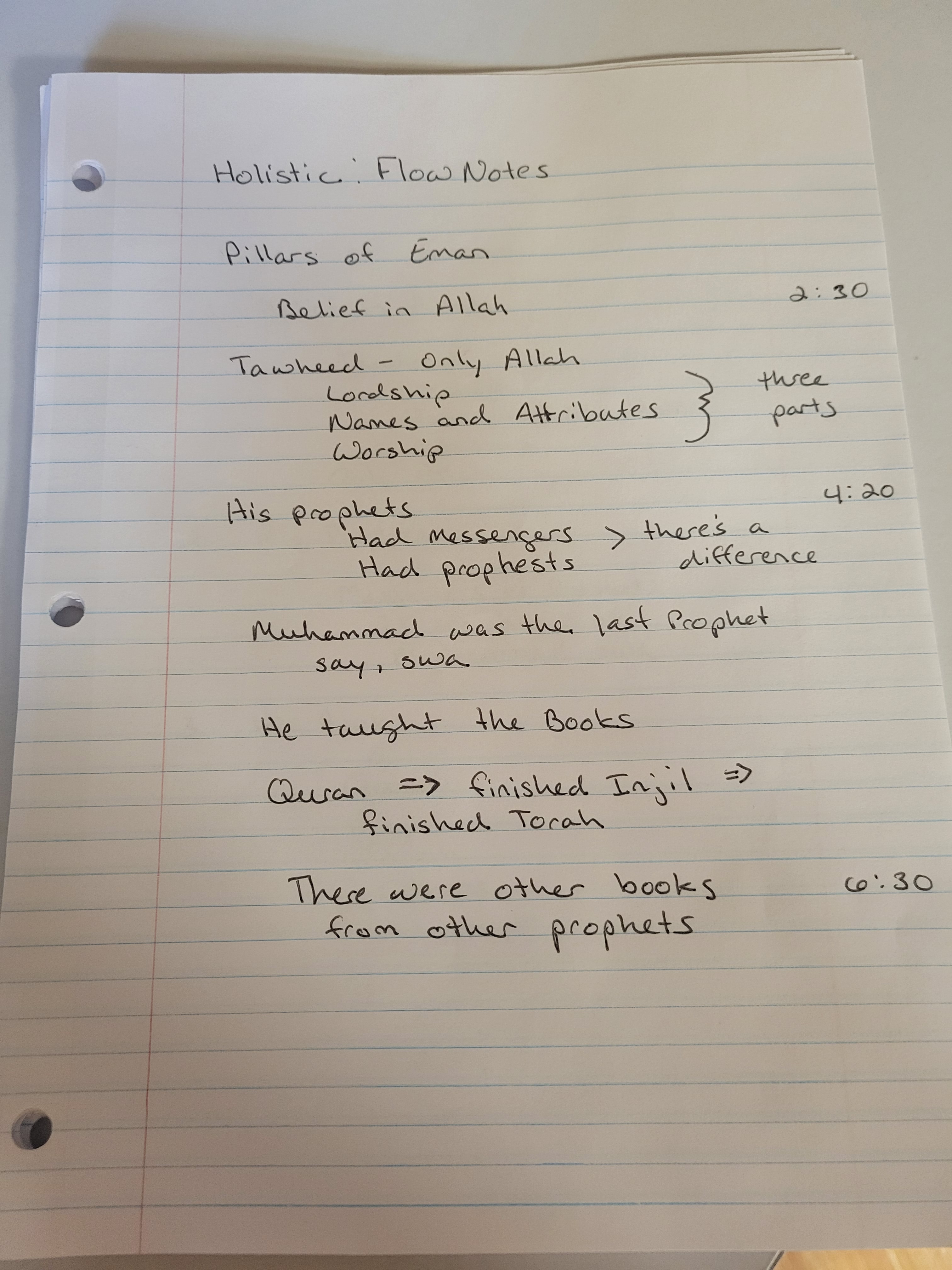
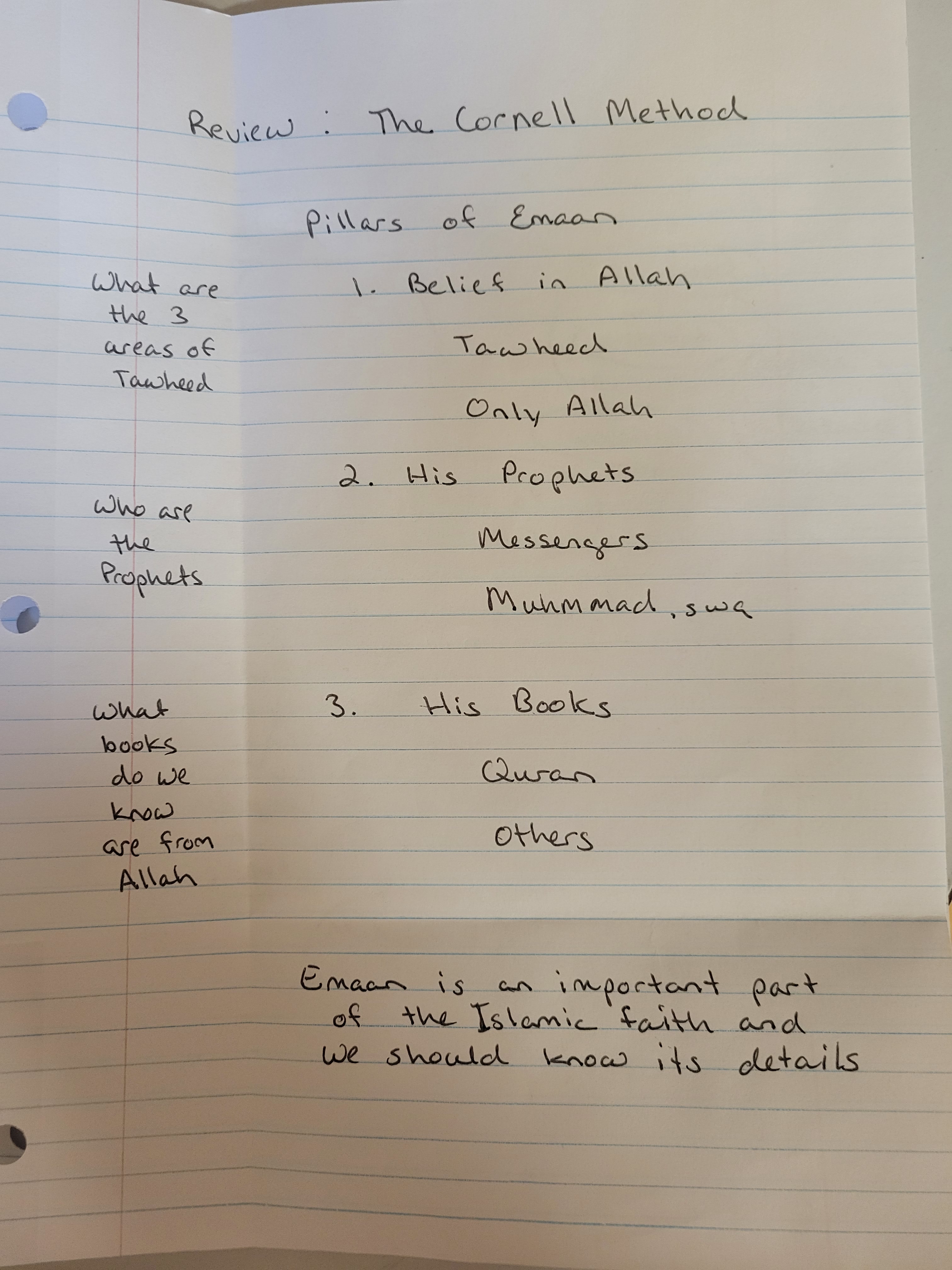
    Note Taking Types

    Here are four note taking types that I find the most effective.

    There are other methods, and I do suggest you do your research and find the method that works best for you.

    Don’t be afraid to doodle on your notes, and if a speaker provides printable slides, try and print those out as well. They are excellent for writing notes on.